Why is my roof flashing leaking around the chimney
Chimney flashing leaks in Bryan, TX almost always trace back to failed sealant, rusted metal, or missing counter-flashing. Here's how to spot it and stop it.
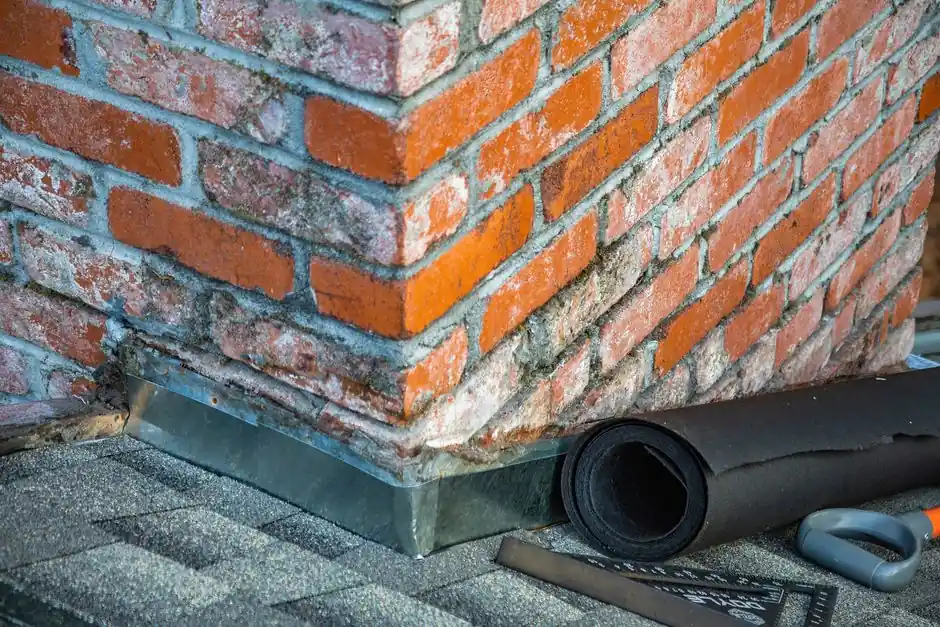
Your chimney flashing is leaking because the metal that seals the joint between your chimney and your roof has failed - usually at the sealant, the fasteners, or the counter-flashing that should be tucked into the masonry. In Bryan, Texas, that failure is almost always driven by two things: ultraviolet radiation baking the caulk and rusting the metal, and wind-driven rain pushing water sideways into gaps that look sealed from the ground. The leak itself is rarely the chimney's fault. It's the flashing.
We fix these every week on homes across Brazos County, and the pattern is consistent. A homeowner notices a brown ring on the ceiling near the chimney after a hard rain, assumes the roof is shot, and starts pricing a full replacement. Nine times out of ten, the shingles are fine. The flashing is done. Here's how to figure out which one you're dealing with, what it costs to fix in 2026, and when it's time to stop climbing the ladder yourself.
What chimney flashing actually does
Chimney flashing is the layered metal system that waterproofs the seam where your chimney passes through the roof plane. It's not one piece. It's a set of pieces that work together: base flashing that sits against the chimney and laps over the shingles, step flashing woven into each course of shingles along the sides, counter-flashing embedded into the mortar joints above, and an apron flashing at the low side that sheds water down the roof.
Each piece overlaps the one below it, and water is supposed to travel down and out - never sideways or up. When any layer pulls away, cracks, or rusts through, water finds the gap. That's the whole mechanism. There's no mystery to it.
The materials matter too. On most Bryan homes we see galvanized steel that's been on the roof 15 to 20 years, aluminum on newer builds, and copper on higher-end homes. Galvanized rusts. Aluminum corrodes in contact with treated lumber and mortar. Copper outlasts the roof itself. If your flashing is original to a house built in the 1990s or early 2000s, it's at the end of its service life.
Why does chimney flashing leak in Bryan TX?
Chimney flashing leaks in Bryan TX because the sealant and metal that hold the joint together degrade faster here than in cooler, wetter climates. Central Texas gets intense summer sun - roof surface temperatures regularly hit 150°F or higher in July and August - and that heat cycles the caulk and the metal every single day. Expansion in the afternoon, contraction overnight, for 20 years.
Here's what that looks like in practice:
- Failed sealant. The caulk bead along the base flashing cracks and pulls away from the chimney wall. Once it opens even an eighth of an inch, water wicks straight in.
- Rusted step flashing. Galvanized steel rusts through at the bends, where the metal is stressed. A pinhole is enough.
- Missing or lifted counter-flashing. Counter-flashing should be set into a mortar joint and sealed. When the mortar cracks or the flashing lifts, wind-driven rain gets behind it.
- Chimney settling. Masonry chimneys move independently of the roof framing. A quarter-inch of movement opens the joint.
- Shingle damage at the flashing line. Shingles butted too tight against the chimney crack when the roof moves.
We also see a lot of bad repairs from previous contractors - sealant smeared over the top of the flashing instead of underneath, or step flashing nailed flat to the chimney instead of woven into the shingles. Those fail within a year or two. If your leak came back after a repair, that's usually why.
If you're seeing water in more than one spot, or the leak shows up during a storm rather than after, the problem may be broader than the chimney. Our team handles Roof Leak Repair Bryan TX across the county and can trace the actual entry point rather than guessing.
How to tell it's the flashing and not the shingles
Flashing leaks and shingle leaks look different once you know what to check. Here's the fastest way to narrow it down from the ground and the attic.
- Check the ceiling stain location. Flashing leaks usually show up within 3 to 6 feet of the chimney on the ceiling or the attic decking. Shingle leaks from wind damage tend to show up at ridges, valleys, or the field of the roof.
- Look at the timing. Flashing leaks often appear during wind-driven rain - water pushed sideways. Shingle leaks show up in any steady rain.
- Inspect the attic after a rain. Look for water tracking down the chimney chase or staining on the roof deck right at the chimney line. That's a flashing leak, not a shingle leak.
- Get on the roof if it's safe. Look for cracked caulk, rust streaks, lifted metal, or shingles that pull away from the chimney. If the caulk is gray and cracked, that's your culprit.
One more thing: don't assume the chimney itself is leaking. Masonry absorbs water, but a chimney that leaks through the brick usually shows efflorescence - white mineral staining - on the exterior. If the brick looks clean and the leak is at the roofline, it's the flashing.
If you're not sure, a Roof Inspection Bryan TX with photos of the actual failure point is worth the cost. We document what we find so you're not guessing.
How to fix chimney flashing leak in Bryan Texas
Fixing a chimney flashing leak in Bryan, Texas means removing the failed materials, not sealing over them. The repair depends on how far the damage goes.
Minor repair: resealing and re-securing
If the metal is sound and only the sealant has failed, we clean the joint, remove the old caulk, and re-seal with a polyurethane or silicone sealant rated for high-temperature exterior use. We also re-secure any lifted flashing with proper fasteners and check the counter-flashing in the mortar joint. This is a half-day job on most homes.
Moderate repair: replacing step and base flashing
When the metal is rusted or bent, we remove the shingles along the chimney, pull the old step and base flashing, and install new pieces woven correctly into the shingle courses. Counter-flashing gets reset into a fresh mortar joint. This is a full-day job and requires matching the existing shingles or accepting a visible patch.
Full flashing rebuild
If the chimney has settled or the flashing system is more than 20 years old, we rebuild the whole assembly - base, step, counter, and apron flashing. On some homes this is the point where a Chimney Flashing Repair Bryan TX turns into a partial roof replacement around the chimney, because the shingles under the old flashing are damaged too.
We also check the chimney cap and the crown while we're up there. A cracked crown lets water into the masonry, and that water shows up as a leak that looks like flashing failure but isn't. Fixing one without the other means you'll be back on the roof next season.
Chimney flashing repair cost Bryan TX
Chimney flashing repair cost Bryan TX runs $350 to $900 for a standard reseal and re-secure, $900 to $1,800 for step and base flashing replacement, and $1,800 to $3,500 for a full flashing rebuild with new counter-flashing. Those are typical 2026 pricing ranges for this area, and they depend on roof pitch, chimney size, and how much shingle work is involved.
What drives the price up:
- Steep roof pitch - anything over 8/12 pitch slows the work and requires more safety setup.
- Chimney height and width - a wide masonry chimney has more linear feet of flashing.
- Shingle matching - if your shingles are discontinued, we may need to source a close match or replace a larger section.
- Decking damage - if water has rotted the roof deck around the chimney, that's a separate repair.
What keeps it lower: a simple reseal on a walkable roof with sound metal. If you catch the leak early, you're usually in the first price range. Wait a year and you're in the third.
We give you the price before we start, and we don't add line items mid-job. If we open up the flashing and find something we didn't expect, we stop and show you.
Common mistakes we see on Bryan roofs
The same mistakes show up on Bryan roofs over and over, and they all make the leak worse.
Sealing over the top of the flashing. Caulk is a supplement, not a substitute. If the metal isn't lapped correctly, sealant just traps water behind it. We pull that off and start over.
Using the wrong sealant. Standard latex caulk fails in one Texas summer. You need a polyurethane or silicone rated for exterior high-temperature use. Even then, it's a 3 to 5 year maintenance item, not a permanent fix.
Nailing step flashing flat to the chimney. Step flashing has to be woven into the shingle courses so each piece laps the one below. Nailing it flat against the chimney wall guarantees a leak.
Skipping the counter-flashing. Some contractors run base flashing up the chimney wall and caulk the top edge. That works until the caulk fails. Counter-flashing set into a mortar joint is the correct detail.
Ignoring the chimney crown and cap. A cracked crown lets water into the masonry, and that water migrates down to the flashing line. You fix the flashing, the leak comes back, and you blame the flashing.
If you've had two or three repairs on the same chimney and the leak keeps returning, the issue is almost certainly the repair method, not the roof. We see this a lot on older homes in Bryan and College Station where the original flashing was installed before modern detailing standards. A Roof Repair Bryan TX that addresses the whole assembly - not just the visible crack - is the only fix that holds.
When to call a professional
Call a professional when the leak is at the flashing line, when you've already tried sealing it once, or when you can see rust, lifted metal, or cracked mortar around the chimney. Those are not DIY fixes. Getting the layering wrong makes the leak worse and can rot the roof deck and framing behind the chimney chase.
We handle chimney flashing leaks across Bryan and the surrounding area. Our team gets on the roof, finds the actual failure point, and fixes it - not the symptom. If the damage extends past the flashing, we'll tell you what else needs attention and what it costs before we start.
If you're dealing with a leak that's already coming through the ceiling, don't wait. Water in the attic means wet insulation, stained drywall, and eventually mold. A fast repair is cheaper than a restoration.
Frequently Asked Questions
Why does chimney flashing leak in Bryan TX?
Chimney flashing leaks in Bryan TX because intense summer heat - roof surfaces hit 150°F or more - cycles the sealant and metal until the caulk cracks and the flashing rusts. Wind-driven rain then pushes water into the gaps. Most failures we see are on flashing that's 15 to 20 years old.
How do I stop a chimney flashing leak in Bryan?
Stop it by removing the failed sealant and flashing, not sealing over them. Clean the joint, replace any rusted step or base flashing, reset the counter-flashing into the mortar, and re-seal with a high-temperature exterior sealant. A proper repair lasts 10 to 15 years. A caulk-over fix lasts one or two.
Can I repair chimney flashing myself in Bryan Texas?
You can reseal a small crack if the metal is sound and you're comfortable on a roof. Anything involving removing shingles, replacing step flashing, or resetting counter-flashing into mortar is a professional job. Done wrong, it traps water and rots the deck. Most homeowners should not attempt it.
Who fixes chimney flashing leaks in Bryan TX?
Roofing contractors who specialize in leak repair, not general handymen. Look for a company that does chimney flashing repair as a core service and can show you photos of the failure point before work starts. We handle these across Bryan and Brazos County.
How much does chimney flashing repair cost in Bryan TX?
Expect $350 to $900 for a reseal and re-secure, $900 to $1,800 for step and base flashing replacement, and $1,800 to $3,500 for a full rebuild with new counter-flashing. Pricing depends on roof pitch, chimney size, and whether the roof deck is damaged.
Get help with Roof Repair in Bryan
If your chimney flashing is leaking, we can get on the roof, find the failure point, and fix it before the next storm. We work across Bryan and the surrounding communities, and we'll tell you exactly what's wrong and what it costs before we start.
Call Bryan Roof Repair Experts at (979) 316 9392 to schedule a chimney flashing inspection or repair.